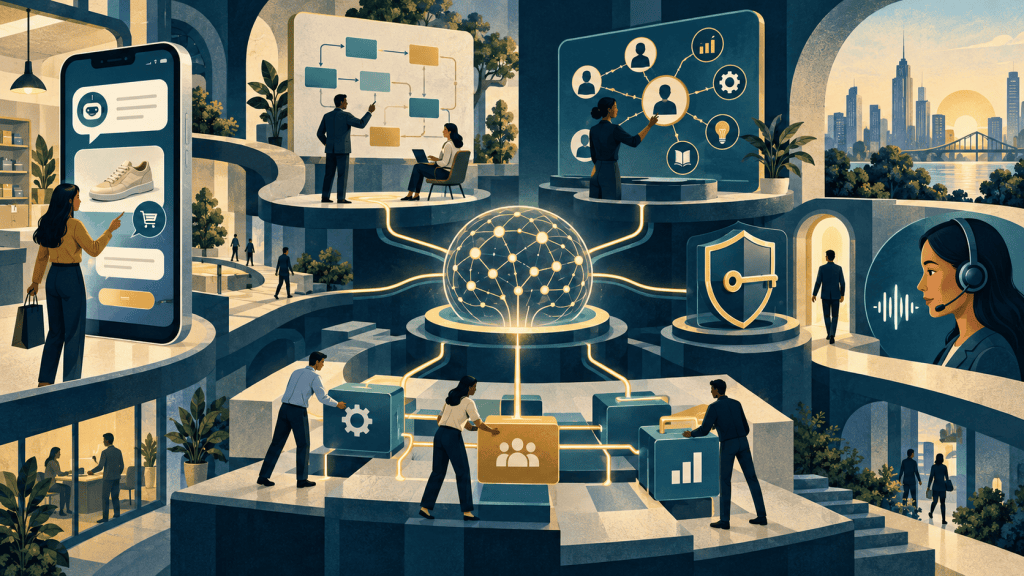
AI is moving from software feature to operating model.
Today’s strongest signals are not about another benchmark. They are about what happens when AI starts controlling customer journeys, changing org charts, mapping work, receiving privileged access to sensitive systems, and handling customer conversations at production scale.
1. TikTok is turning the ad platform into an agentic commerce layer
TikTok unveiled a broad set of AI changes that push the platform much further down the customer journey. Buy Direct enables one-click purchases from the For You feed while keeping the brand as merchant. Shopping Assistant is a conversational agent that can answer questions about products, sizing, shipping and availability. Agentic Leads can qualify prospects in TikTok DMs and on advertiser-owned websites. TikTok is also opening its third-party ad network to U.S. advertisers across nearly 400,000 apps.
The connective tissue is TikTok for Business MCP. It lets AI agents plan, launch and manage advertising workflows directly against TikTok’s ad system and is now available through platforms including Claude, Perplexity, Snowflake and Replit. TikTok says advertiser use of its MCP for activation and management increased more than 200% from July through September, although that is internal company data and TikTok does not disclose the starting base.
The big picture
This is a more consequential shift than simply adding AI to Ads Manager. TikTok is trying to connect discovery, media buying, lead qualification, product advice and checkout inside one increasingly agentic system.
For marketers, that moves the competitive advantage away from manual campaign operation. Product data, creative governance, margin rules, measurement and the instructions an agent can safely act on become more important. The platform increasingly handles the mechanics while the business has to define the constraints.
Read more: TikTok, AI-powered advertiser and commerce updates
2. AI is entering the org chart, not just the software budget
Three workforce announcements in roughly 24 hours make the trend harder to dismiss as rhetoric.
FICO said it will cut about 15% of its workforce as part of a broader restructuring and AI integration. Based on its last disclosed headcount, that could affect roughly 570 employees. The company expects about $27 million in restructuring charges. FICO also faces major competitive and regulatory pressure in its core credit-scoring business, so it would be too simple to attribute the restructuring entirely to AI.
Norway’s DNB said it will eliminate about 400 jobs in Technology & Services after increasing investment in AI agents and digital systems. DNB says agents are already replacing some previously manual tasks. Meanwhile, the Financial Times reported that HSBC is considering substantial reductions in its UK wealth operation, including roughly half of management and specialist roles and potentially around 70% of financial advisers. HSBC is still in consultation, so those proposed cuts are not final.
The big picture
The notable change is that AI is now appearing explicitly inside formal workforce restructuring decisions.
That still does not mean every eliminated job has been replaced one-for-one by a model. Cost pressure, competitive threats, digitization and organizational simplification are mixed together. But companies are beginning to redesign staffing around an assumption that more work can be performed by software and smaller teams.
The management challenge is moving from “give employees AI tools” to a harder question: which tasks should still exist, who owns the outcome, and what evidence proves the redesigned organization is actually better?
Read more: Reuters, HSBC plans UK wealth cuts in AI push | Reuters, FICO cuts 15% of workforce | Reuters, DNB cuts jobs amid AI-driven changes
3. SAP is buying the map of how work actually gets done
SAP agreed to acquire TechWolf, whose software builds a continuously updated model of an organization’s work, the tasks inside individual jobs, employee skills and the external labor market. Financial terms were not disclosed, and the acquisition is expected to close in the fourth quarter subject to regulatory approval.
SAP plans to make TechWolf’s “context graph for work” a core part of SuccessFactors and use it to support hiring, reskilling, redeployment and organizational redesign. SAP also says the data will provide grounding for Joule agents making decisions about workforce and skills. Claims that the integration will reduce token usage or improve agent efficiency are forward-looking vendor assertions, not demonstrated acquisition outcomes.
The big picture
Enterprise AI has a context problem.
An agent can read an HR system and still have very little idea what a person actually does, which skills are being used, which tasks can be automated, or which capabilities the company is about to lose. SAP is effectively buying a semantic layer for work.
That is a useful signal for the broader enterprise market. If companies seriously intend to redesign processes around agents, they will need machine-readable maps of roles, tasks, skills, policies, systems and ownership, not simply access to rows in existing databases.
Read more: SAP, agreement to acquire TechWolf | Reuters, SAP to acquire workforce data firm TechWolf
4. Anthropic is putting powerful AI capability behind a permissioning system
Anthropic expanded its Cyber Verification Program into three levels of access to its most capable models.
Defense Access covers areas such as incident response, malware analysis and vulnerability work. Red Team Access permits authorized penetration testing with fewer restrictions. Specialized Access goes further and is reserved for vetted organizations working on high-consequence systems such as power grids, telecom networks, financial infrastructure and flight systems. Anthropic says those organizations receive deeper review in collaboration with the U.S. government.
The company says Project Glasswing partners found at least 129,000 verified vulnerabilities between April and July, while Anthropic’s own open-source scanning found another 5,500 through October. More than 33,000 have been rated high or critical severity. Those numbers come from Anthropic and partial partner reporting, so they should be treated as company-reported evidence rather than an independent measurement of effectiveness.
The big picture
This could become a useful model for governing other high-risk AI capabilities.
Instead of deciding that a capability is simply available or unavailable, Anthropic is tying what the model may do to verified identity, authorized purpose, organizational controls, monitoring and data policy.
As models become capable enough to perform sensitive actions, permissions may become as important as intelligence. The enterprise version of AI safety may ultimately look less like a universal content filter and more like a sophisticated access-control system.
Read more: Anthropic, expanded Cyber Verification Program | Reuters, Anthropic opens advanced models to more security teams
5. Voice agents are becoming customer-operations infrastructure
ElevenLabs says it plans to invest “hundreds of millions of dollars” in India, expanding local teams, model development and support for Indian languages. The exact investment has not been disclosed. The company is also considering acquisitions in the country.
More interesting than the investment figure is the operating footprint ElevenLabs is claiming. Its India leader says the company has worked with 250 enterprises in the region and now handles about 100 million AI-agent conversations annually across 14 Indian languages. ElevenLabs markets integrations with local telephony and CRM systems, human handoffs, data residency and regulated-industry controls. The conversation volume is company-reported rather than independently audited.
The big picture
Voice AI is moving past the impressive-demo phase.
To become real customer infrastructure, the system has to work with phone networks, CRM data, accents, multiple languages, noisy environments, escalation rules, compliance requirements and human service teams. That surrounding machinery is increasingly where the differentiation sits.
India is an unusually demanding test because of its scale, linguistic diversity and high-volume customer-service market. If voice agents can work reliably there, the implications extend well beyond call centers. The telephone becomes another programmable interface into enterprise workflows.
Read more: Reuters, ElevenLabs plans major India investment | ElevenLabs, voice AI for Indian enterprises
THE THROUGH LINE
The operating model is becoming the real AI battleground.
TikTok is letting agents reach deeper into media, commerce and customer decisions. HSBC, FICO and DNB are redesigning organizations around the assumption that software will perform more work. SAP is buying a richer map of tasks and skills because agents need context about how an organization actually functions. Anthropic is experimenting with identity and permission systems for powerful capabilities. ElevenLabs is building the telephony, language and enterprise infrastructure required for agents to handle live customer interactions.
The pattern is becoming clearer.
Access to intelligence is getting easier. Turning that intelligence into authorized action inside a real business is still hard.
The companies creating durable value may be the ones that solve everything around the model: context, permissions, workflow integration, measurement, economics and accountability.

